 Wadi Rum Desert Tours
Choosing a Wadi Rum Camp for the Night: Types, Prices and What to Expect
A Wadi Rum camp is the only way to sleep inside the desert itself, and most visitors book one night paired with a jeep tour rather than a camp on its own. The choice comes down to four things: the type of tent you sleep in, whether the camp sits inside the UNESCO protected area or outside it in Disi, what the night includes, and what it costs. Camp nights here usually come with dinner, often a zarb cooked in a sand pit, breakfast, tea, and a jeep tour attached. They usually lack air conditioning and internet, so set expectations before you book. Wikivoyage puts the reference price at 20-80 JD ($28.20-$112.80) per person per night with meals. This guide explains the camp types, the inside-versus-Disi question, and how the overnight trips in Wadi Rum desert tours compared catalogue compare on price, sleeping arrangements, bathrooms, group size and cancellation.
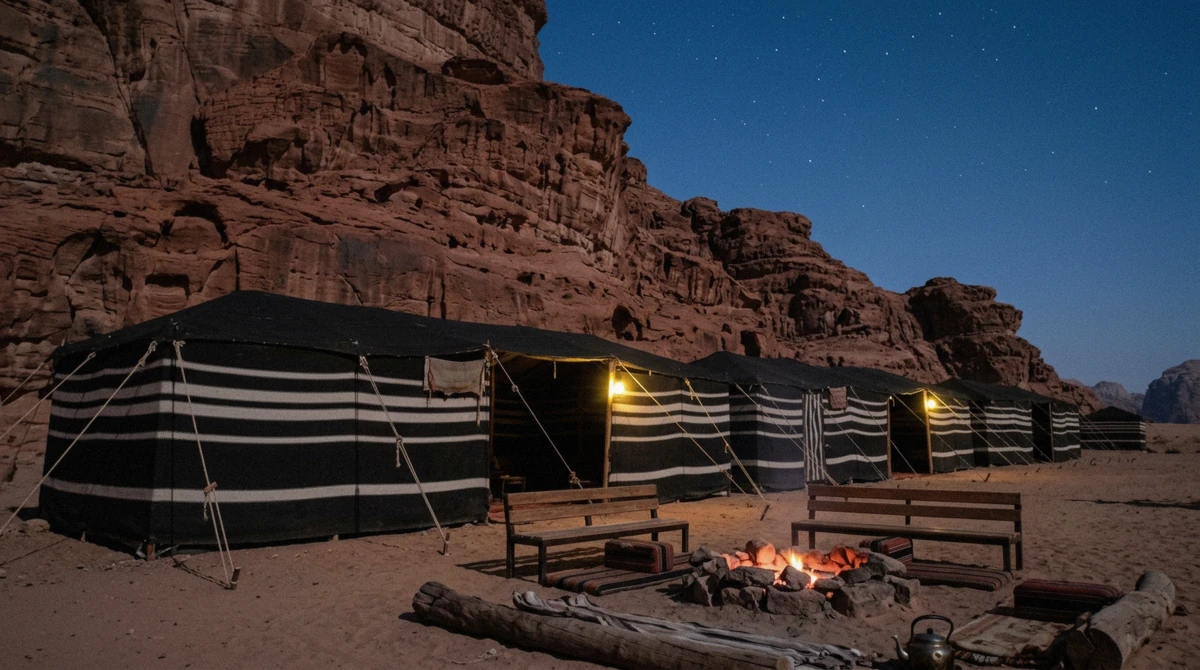
Illustrative image of a Bedouin camp at blue hour.
Quick answer Camp types, inside vs Disi, what a night includes and how to choose
Most travellers should book a camp inside the Wadi Rum Protected Area with a private tent and a full jeep tour attached, because the camp is the whole point of the night and the scenery is what you paid for. A traditional Bedouin camp with shared bathrooms is the cheapest and most social option, while private tents with their own bathroom cost more and suit couples and families. Cave or semi-wild camping gives the wildest night, with no bathroom mentioned in the listing. Camps in Disi sit outside the reserve and give a different experience. Expect dinner, often zarb cooked in a sand pit, breakfast, tea and usually a jeep tour, with no air conditioning and no internet.
Key takeaways
- Best all-round option: a private tent inside the protected area with a full jeep day, as in the full-day jeep tour with overnight and dinner in a Bedouin camp.
- Lowest rate in the catalogue: the Bedouin camp stay with a full-day desert tour and 3 meals at $53 per person with a private bathroom.
- Most authentic night: cave camping with a half-day jeep tour, semi-wild, rated 5.0 but with a 3-day cancellation window.
- Disi camps sit outside the UNESCO protected area, so touts offering free entry may take you into a different desert entirely.
- Nights are cold outside summer: January averages 3.2°C (38°F) after dark, so pack a warm layer whatever tent you choose.
Which camp night should you book?
If you want the fullest day and the best-reviewed listing
Choose the full-day jeep tour with overnight and dinner in a Bedouin camp, ten sites from 10:00 to sunset, three meals and a private tent for $106.53.
If you are travelling on a tight budget
Take the Bedouin camp stay with a full-day desert tour and 3 meals, $53 per person with a private tent and private bathroom, children under 11 stay free.
If you care more about the night than the bathroom
Book cave camping with a half-day jeep tour, semi-wild camping at a cave with equipment provided, but cancel at least 3 days ahead or lose the money.
If you have no car and are coming from Amman
Consider the Petra and Wadi Rum day trip from Amman, though note it gives the desert only about 2 hours and no camp night.
If you only want the desert by day
Skip the camp and book the half-day private jeep tour or the 9-hour jeep tour with camel ride, sandboarding and lunch instead.
Camp types in Wadi Rum
Four kinds of camp night are sold in Wadi Rum, and they differ mainly in bathroom arrangements and how close to nature you sleep. No single type is best for everyone, so match the type to how much comfort you need after a day in the sand.
Traditional Bedouin camp
Black goat-hair tents around a communal fire, the classic Wadi Rum image. Bathrooms are usually shared and modern, as with the full-day jeep tour listing, which offers a private Bedouin tent with modern shared toilets, showers and a charging station. This is the most social format, with dinner served around the fire.
Private tent with bathroom
The comfort option. The camp in the camp-stay listing sleeps 30 to 35 people in private tents for 1 to 3 guests, each with its own bathroom, shower and towels. Even here there is no air conditioning and no internet, so do not book it expecting hotel standards.
Cave or open semi-wild camping
A mattress and blankets at a cave in the desert, equipment provided, nothing else. The cave camping listing in this catalogue works this way for groups of up to 8. You get the open sky, and the listing mentions no bathroom.
Bring a warm layer, because the night is outdoors.
Dome tents sold as Martian or bubble tents
Dome tents with clear walls are marketed as Martian or bubble tents, a nod to the Mars films shot here. They give a view of the stars from the bed. No dome camp appears in this catalogue, so no dome price is quoted here.
Inside the protected area or Disi?
Camps sit either inside the Wadi Rum Protected Area, the UNESCO World Heritage Site, or in Disi (Disah) outside it. Wikivoyage notes the two give a different experience from each other, and one listing warns that touts offering free entry are often from Disah and take you into the other desert, not the UNESCO area.
- Inside the reserve: the rock formations, canyons and red dunes the tours visit, dark enough for serious stargazing.
- Disi, outside it: a different experience outside the UNESCO area, sometimes marketed with free entry offers that do not apply to the protected area.
- Practical check: the protected-area entrance fee is 5 JD ($7.05) per person for foreign visitors, covered by the Jordan Pass, and children under 12 enter free. If nobody mentions an entrance fee, ask where the camp actually sits.
- Access: the Visitor Centre is 21 km from the Desert Highway turnoff and Rum Village a further 7 km on. Most camps inside the reserve arrange pickup from the village or the Visitor Centre.
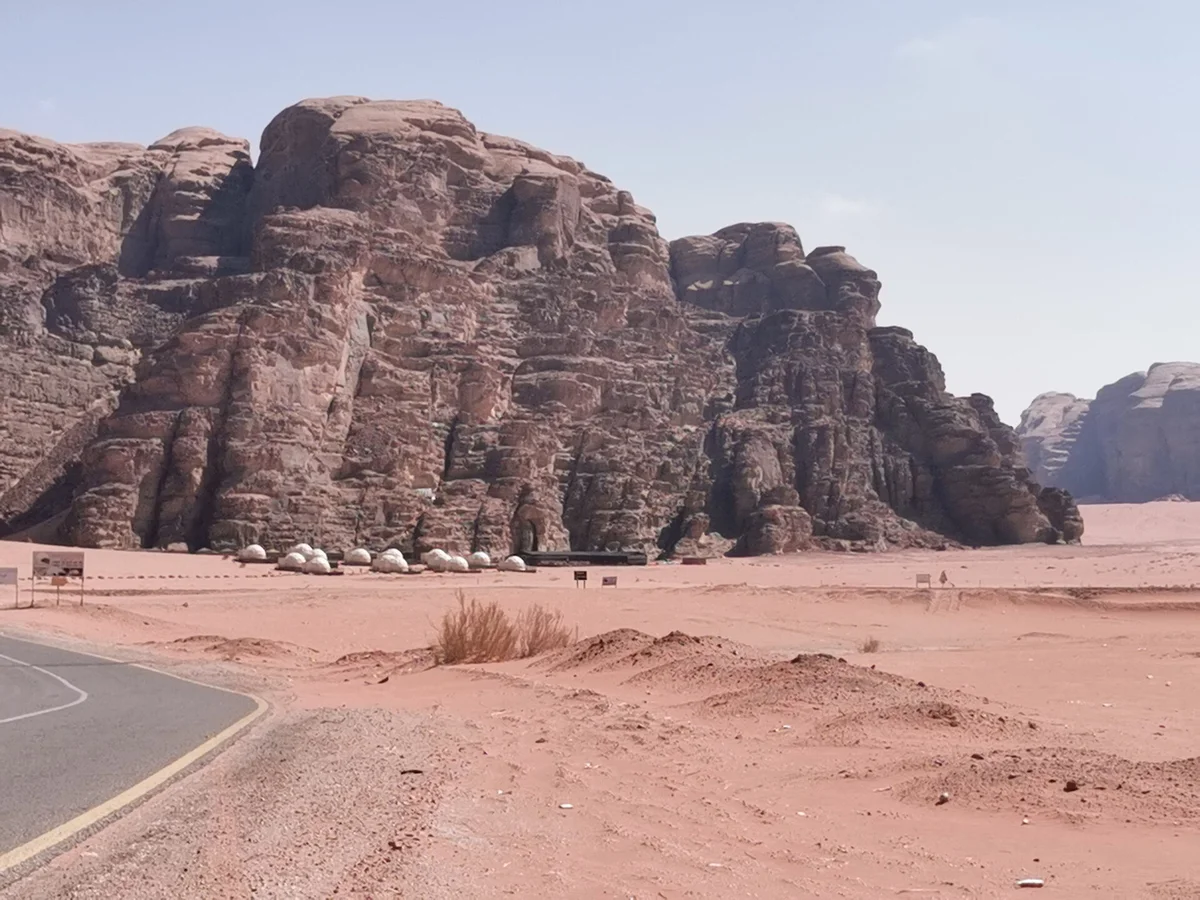
A Bedouin camp with traditional tents and dome pods below the cliffs. Photo: Irina Alexandra S., CC BY-SA 4.0, via Wikimedia Commons.
What a camp night usually includes
A camp night is usually sold as a package with a jeep tour, and the meals and extras follow a familiar pattern across listings. Read the inclusions carefully, because the entrance fee is excluded from every trip in this catalogue.
- Dinner, often a zarb, the Bedouin barbecue cooked in a sand pit. The camp-stay listing names the zarb explicitly.
- Breakfast the next morning, with the trip ending after it.
- Lunch on full-day trips, cooked on the fire in the jeep-and-camp listing or as a 1 to 2 hour Bedouin lunch in the camp-stay listing.
- Tea and bottled water throughout, coffee and snacks on the cave trip.
- A jeep tour is nearly always part of the package rather than an add-on.
- Transfers between Wadi Rum Village and the camp, as on the full-day jeep tour listing.
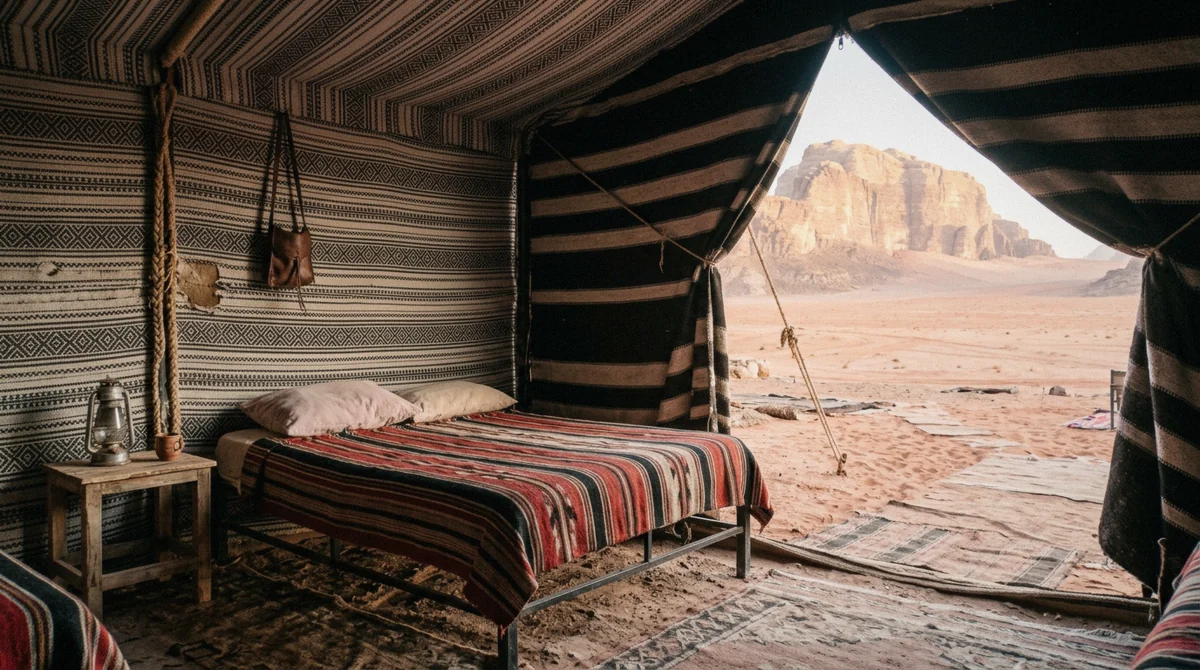
Illustrative image of a private tent at a desert camp.
What camps lack
Camps are not hotels, and the gaps are consistent across listings.
- No air conditioning, stated plainly even in the private-bathroom camp-stay listing.
- No internet, also stated for that camp, and no phone signal in much of the desert.
- Shared bathrooms in traditional Bedouin camps, and no bathroom mentioned for semi-wild cave camping.
- Cold nights for most of the year. January averages 3.2°C (38°F) after dark, and the listings advise warm clothes.
- Cash matters. The jeep-and-camp listing charges 10 JOD ($14.10) extra for a Visitor Centre transfer unless you drive to the village, and parking at the Rest House costs 5 JOD ($7.05) in cash on one listing while another calls it easy and free.
What a camp night costs
The table compares the overnight trips in the catalogue, which combine a jeep tour, dinner and a night in camp, with prices taken from the listings themselves and the per-night reference from Wikivoyage. The entrance fee is extra on every trip.
| Trip | Price per person | Jeep tour | Sleep and bathroom | Group size | Cancellation |
|---|---|---|---|---|---|
| Full-day jeep tour and camp night | $106.53 | 10:00 to sunset, ten sites | Private Bedouin tent, modern shared toilets and showers, charging station | Up to 15 | Free up to 24 hours before the start |
| Camp stay with full-day tour and 3 meals | $53 | 8 hours, private or small group | Private tent for 1-3 guests with private bathroom and shower, towels | Up to 7 | Free up to 24 hours before the start |
| Cave camping with half-day jeep tour | $126 | From 14:00, 4-5 hours, 32.3 km | Semi-wild camping at a cave, equipment provided, no bathroom mentioned | Up to 8 | Full refund 3 days or more ahead, no refund after |
Wikivoyage's reference for arranging a camp yourself in the village is 20-80 JD ($28.20-$112.80) per person per night with meals, with 4x4 tours at 50-75 JD ($70.50-$105.75) per jeep for 3-5 hours and a camel at about 20 JD ($28.20) per hour. Booking a package is usually the simpler route, because tour, dinner and bed arrive as one price. For the wider price picture across day trips, see Wadi Rum tours.
Camp price reference: Wikivoyage Wadi Rum. Background on the protected area: UNESCO World Heritage listing.
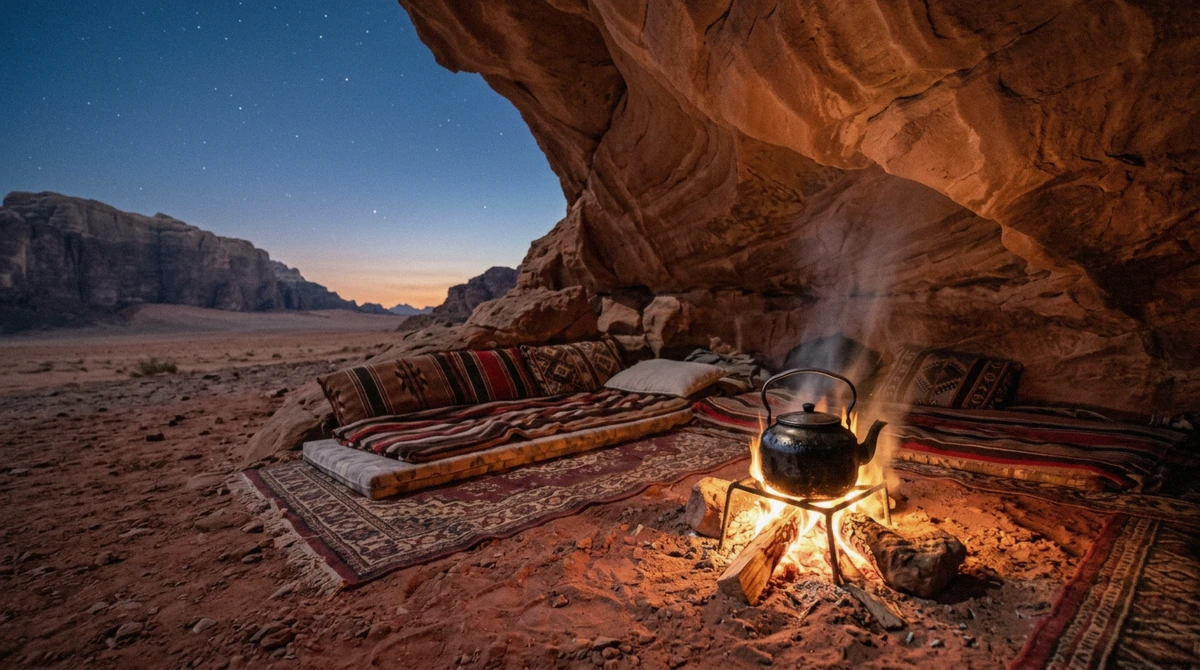
Illustrative image of a cave camp at dusk.
How to pick your camp night
Start with the tour, then let the camp follow. The jeep itinerary decides most of your day, and every overnight trip here cover the headline sites: Lawrence Spring, Khazali Canyon, the red sand dune and Um Fruth Rock Bridge appear on each.
- Want the longest desert day? The full-day jeep tour runs from 10:00 to sunset across ten sites including Burdah viewpoint and the White Desert, and it is the most reviewed overnight trip here at 4.9 from 383 reviews.
- Want the cheapest night? The camp-stay listing at $53 is the lowest per-person rate in the catalogue for a full tour and a night, and children under 11 stay free. The camp sleeps 30 to 35 people, so dinner is communal.
- Want solitude? The cave trip caps at 8 travellers and sleeps away from any camp building, rated 5.0 from 227 reviews. Accept the 3-day cancellation window and a night with no bathroom mentioned.
- Travelling with small children? The jeep-and-camp trip takes all ages with infants on an adult's lap, and the camp-stay listing lets under-11s stay free. The cave trip requires ages 6 and over.
- Bad-weather flexibility? Only the cave trip restricts you, so if winter weather worries you, the 24-hour listings are safer. The jeep-and-camp listing also allows cancellation in bad weather.
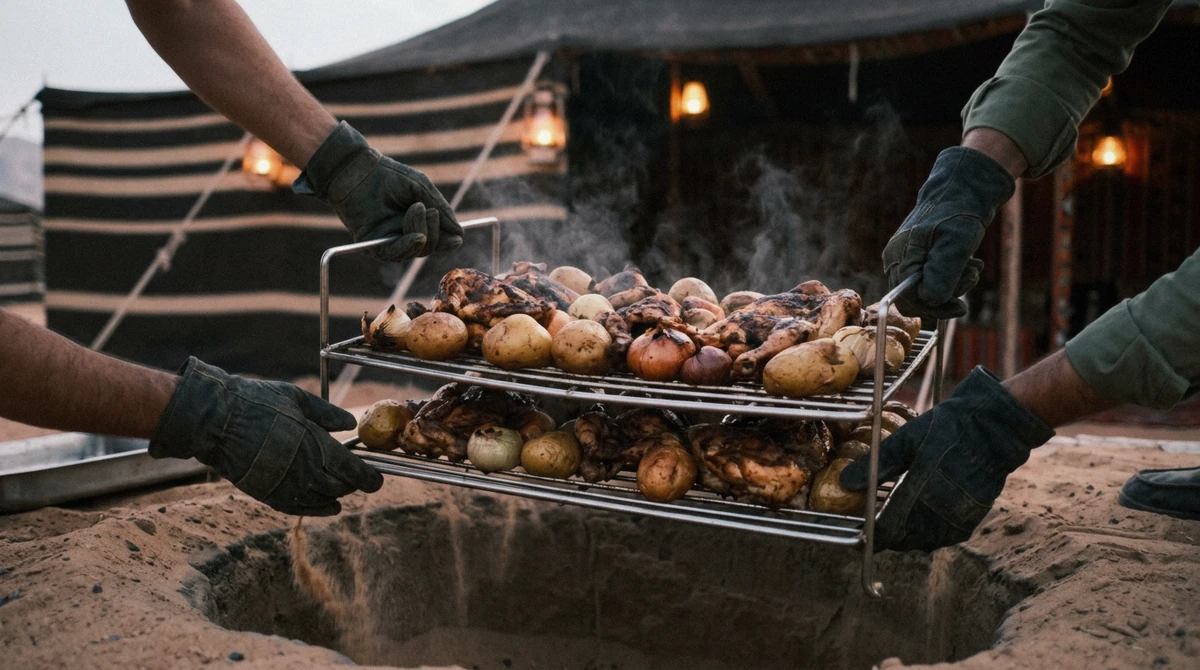
Illustrative image of a zarb, the dinner cooked in a sand pit.
A night paired with other desert activities
A camp night slots naturally into a longer stay, and several daytime trips pair well with an overnight in either direction.
- Add hot air balloon flight over Wadi Rum at sunrise the morning after your camp night, with free pickup from eligible camps inside the reserve. Book it for your first morning and keep the second as a weather backup.
- Book stargazing at the observatory after dinner, about 1.5 hours with telescopes and free transfer from most camps.
- Add a camel ride with Bedouin tea and guide the next morning, which can even start from a camp inside the protected area.
- If your night is in Disi or you skip the camp entirely, the 9-hour jeep tour with camel ride, sandboarding and lunch packs the desert into one long day instead.
When to sleep in the desert
Season matters more for a camp night than for a day visit, because you are outside after dark. The figures come from Open-Meteo ERA5 reanalysis, daily data for 2001 to 2025.
| Season | Typical day / night | What it means for the camp |
|---|---|---|
| Spring (March to May) | About 21°C (70°F) to 30°C (85°F) by day, 8°C to 16°C (46-61°F) at night | Wikivoyage's recommended window, warm days and manageable nights |
| Summer (June to August) | About 33°C (91°F) to 34°C (94°F) by day, 18°C to 20°C (64-68°F) at night | Hot afternoons, but the most comfortable nights of the year with no rain |
| Autumn (September to November) | About 21°C (70°F) to 32°C (90°F) by day, cooling to 9°C (48°F) by night | Another recommended window, pack a warm layer from October |
| Winter (December to February) | About 14°C (58°F) to 16°C (61°F) by day, 3°C (38°F) to 5°C (41°F) at night | Cold nights, the listings advise warm clothes |
Rain is rare, under 8 mm a month even at the wettest. For month-by-month detail see our guide to the best time to visit Wadi Rum.
What to pack for the night
Listings repeat a short packing list across every overnight trip here, and it costs nothing to follow it.
- A warm layer for the evening and morning, even in spring and autumn, because desert nights run far colder than the afternoons.
- Comfortable desert shoes for walking and scrambling at the stops.
- Sun protection for the day and a headscarf if you ride a camel.
- Cash for the entrance fee, 5 JD ($7.05) with the higher figure of 7 JD quoted by some sources, plus any extras such as the 10 JOD ($14.10) Visitor Centre transfer.
- A power bank, since charging stations exist in some camps but not in cave camping.
- A towel if your trip is the cave one, where the listing names camping equipment and nothing more.
Planning the rest of the trip
A camp night is one piece of the logistics. Getting to Rum Village, the entrance fee and how many nights to allow all shape whether the night works.
- Getting there: Aqaba is about 60 km (37 mi) away, with minibuses at 1-3 JD ($1.41-$4.23) and taxis at 25-35 JD ($35.25-$49.35) one way. From Petra one bus runs at 06:00 for 7 JD ($9.87). Details in how to get to Wadi Rum.
- Entrance fee and Jordan Pass: the 5 JD ($7.05) fee is covered by the Jordan Pass, bought before arrival. Full breakdown in Wadi Rum entrance fee and the Jordan Pass.
- How long to stay: one camp night suits most itineraries, two gives a weather buffer for activities such as the balloon flight. See how long to spend in Wadi Rum.
- Film fans: several tours stop at places the listings link to The Martian and Lawrence of Arabia, which adds context to the Martian-tent marketing. More in Wadi Rum film locations.
Questions and Answers
Which camp is the best in Wadi Rum?
This site never names individual camps, so there is no single best answer. What the listings show is that format matters more than name: a private tent with its own bathroom inside the protected area suits most travellers, while cave camping suits those who want the wildest night. Compare the overnight trips here and pick by sleeping arrangement, group size and cancellation terms rather than by camp branding.
Why are Wadi Rum camps so cheap?
Because the camp itself is simple. Wikivoyage's reference price is 20-80 JD ($28.20-$112.80) per person per night with meals, and the cheapest overnight package in this catalogue is $53 including a full 8-hour tour, three meals and a private tent. Tents, not hotel rooms, shared bathrooms in the traditional format, and meals cooked on site keep costs low. No air conditioning and no internet also keep the price down.
Are Wadi Rum bubble tents worth it?
They suit travellers who want to watch the stars from bed without sleeping outside, and the clear-walled domes are marketed as Martian or bubble tents because Mars films were shot here. No dome camp appears in this catalogue and no dome price is quoted here, so we cannot compare value. If a private bathroom matters, check the inclusions before booking.
Is it safe to stay in a Wadi Rum camp?
The camps are run by Bedouin families from Rum Village, mostly of the Zalabieh tribe, who have hosted visitors for decades, and the listings describe supervised trips with guides throughout. The real risks are environmental rather than human: cold nights, no phone signal in the desert and remote sleeping in the cave format. Bring the warm layer the listings insist on and tell your operator of any back problems, which several listings specifically flag.
Do Wadi Rum camps have showers?
Many do. The jeep-and-camp listing provides modern shared toilets and showers, and the camp-stay listing gives every private tent its own bathroom and shower with towels. The cave camping listing mentions none, which is the trade for sleeping at a cave. No listing mentions air conditioning or internet in any camp.
How many nights should I stay in Wadi Rum?
One night with a full jeep day covers the highlights for most visitors and is how every overnight trip here in this catalogue are built. Two nights make sense if you want a sunrise balloon flight, since weather can cancel a flight and a spare morning protects the plan. The overnight listings end the morning after breakfast, so a same-day departure to Petra or Aqaba works fine after one night.